Are you really making money on Vinted?
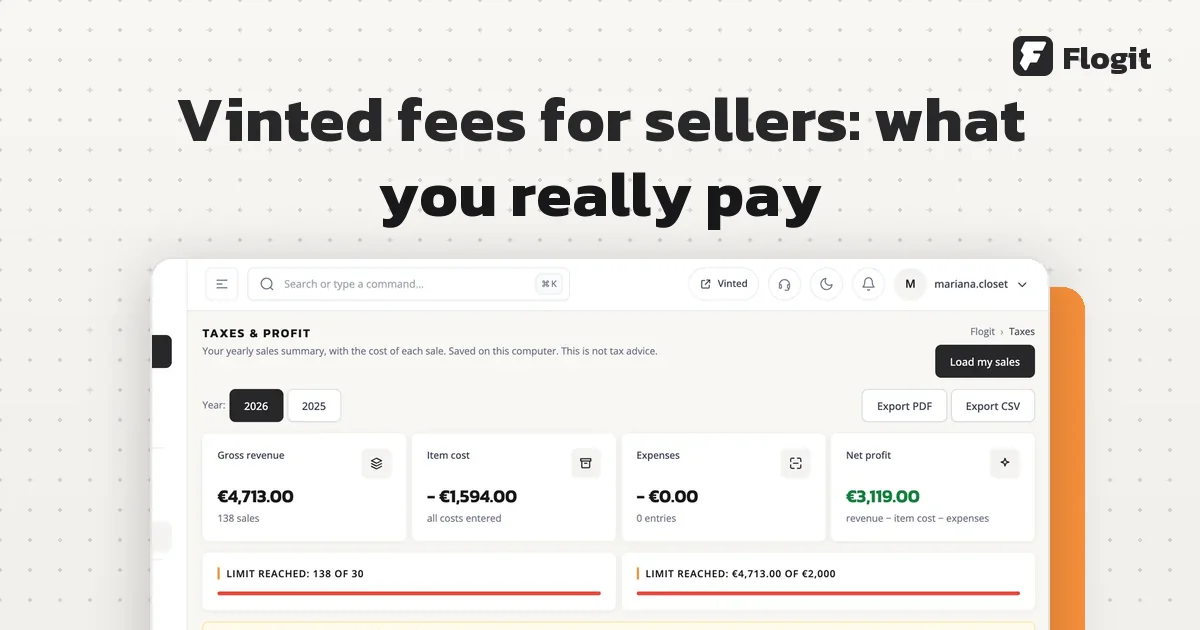
What you sold and what you earned are two different numbers. Here is a simple way to find your real profit, with a small example you can copy.
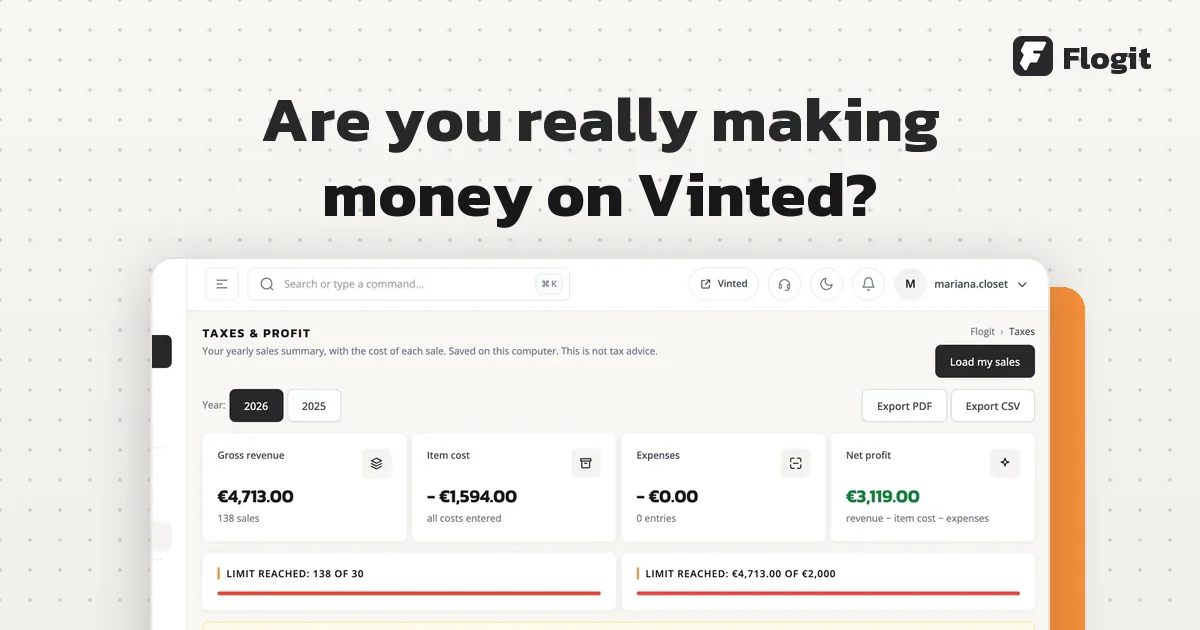
Start with the price you got for the item. Take off what the item cost you, any bundle discount, what you paid for Bumps or Showcase, and your packaging. What is left is your profit, and it is almost always smaller than your sales.
What you get when an item sells
Vinted takes nothing from the seller. There is no fee to list an item and no fee when it sells. When the sale is closed, you get the full price you set, straight into your Vinted Wallet. Source: Is selling on Vinted free?
The buyer pays the Vinted fee (Buyer Protection) and the postage on top of your price. That money never reaches you, so leave it out of your sums. We explain the buyer's fee in Vinted fees for sellers.
What comes off before it is profit
Four things can eat into the price you get:
- What the item cost you. The price you paid in the charity shop, at the car boot sale or in the shop.
- The bundle discount. If a buyer takes several items and you have a bundle discount switched on, that percentage comes off your price.
- Bumps and Showcase. These are the paid options for sellers. You only pay if you choose them.
- Packaging. Mailing bags, boxes, tape and printer ink add up over a year.
You set the bundle discount yourself, in your settings, and you choose how much it is for each number of items. The bigger the discount, the more of it comes out of your money. Source: Set up a discount for your closet
A Bump pushes one item higher in the newsfeed and search results for 3 or 7 days, or until it sells. The cost is shown at checkout before you pay. Source: Additional services to boost your listings
Showcase boosts all your listings at once and lasts 7 days. The fee is shown at checkout, before you pay. Source: Showcase
A worked example with three small items
Say you sold three things this month. A jumper for 12 EUR that you bought for 3 EUR. Then a pair of jeans and a top, bought for 5 EUR and 2 EUR, sold together to one buyer. Their prices were 15 EUR and 8 EUR, and your 10% bundle discount took 2.30 EUR off, so you got 20.70 EUR.
You also bumped the jumper once. In this example the Bump cost 1.50 EUR, but the real price is the one Vinted shows you at checkout. Each parcel took a mailing bag at about 0.50 EUR.
| Sale | You got | Item cost | Extras | Profit |
|---|---|---|---|---|
| Jumper | 12.00 EUR | 3.00 EUR | 2.00 EUR | 7.00 EUR |
| Jeans and top (bundle) | 20.70 EUR | 7.00 EUR | 0.50 EUR | 13.20 EUR |
| Total | 32.70 EUR | 10.00 EUR | 2.50 EUR | 20.20 EUR |
Extras are the Bump and the mailing bags. Your sales were 32.70 EUR. Your profit was 20.20 EUR. Without the Bump, the jumper would have made 8.50 EUR.

Sales and profit are two different numbers
Sales is the money buyers paid for your items. Profit is what stays with you after your costs. A month with lots of sales can still be a weak month if you paid too much for the stock or bumped everything.
The opposite is also true. A few items bought for almost nothing can give you a better month than a busy one. Look at profit per item, not only the total.
The money you collected is not what you sold
Money does not reach your balance the day someone buys. It shows as pending first. It reaches your available balance within 2 days after the order is completed. An order is completed when the buyer confirms it, or 2 days after delivery if they do nothing. Source: Getting paid for a completed sale
A withdrawal to your bank can then take up to 5 business days. So an item sold on 29 March may reach your bank in April. Source: How to withdraw earnings
That is why your bank statement is a poor guide to your sales. Count a sale in the month it was completed, and keep withdrawals out of your profit sums.
Your Vinted balance has a history you can open by year, with your earnings and your withdrawals. It is a list of money in and out, not a profit report: it does not know what your items cost you.

Keep a simple record
A notebook works. A spreadsheet is easier to add up. Keep one line per item:
When you buy
Write the item, the date and what you paid. A small label in the bag with the price helps later.
When it sells
Add the date and the price you got, after any bundle discount.
When you pay for extras
Note each Bump or Showcase next to the item or the week it was for.
Once a month
Add up packaging, then take everything off your sales. That is your profit for the month.
Your own clothes and tax
If you are clearing out your own wardrobe, you usually sell for less than you paid. That is not really profit. Vinted says that, in general, selling personal items on Vinted is not taxed. If you make at least 30 sales or earn over 2,000 EUR in a calendar year, Vinted reports your sales to the tax authorities the next year, and you get a copy too. Source: Vinted on DAC7
Buying items to sell them on is different, and the rules depend on your country. Your record of costs and profit is exactly what your tax office will want to see, so ask them.
Flogit shows your sales from your Vinted account, and the profit per item and per month once you add what each item cost you. On Trader and up, the Taxes page adds a yearly profit and loss report that you can export as a CSV. We explain it in Vinted tax and DAC7.